Horizontal
Double swipe → your site
Two quick swipes the same way open the address you assigned to that direction — one for left, one for right. Point them at the inbox and the tracker you open forty times a day.
Touchpad gestures · Chrome & Edge
Not new movements to learn: the same two-finger swipe, flick and pinch you already make. The browser drops them; Glidepad turns them into opening a site, going Back, reloading a page and handling tabs.
Chrome and Edge on Windows · no account, no sign-in
no network requests, no page content read
Live check
streamThe gestures
Your hand already makes all five. Glidepad only decides what they mean.
Horizontal
Two quick swipes the same way open the address you assigned to that direction — one for left, one for right. Point them at the inbox and the tracker you open forty times a day.
Horizontal
Nothing is taken away. One swipe still walks browser history — it just waits out the window for a second swipe first. Leave a direction empty and even that wait disappears.
Vertical
Two sharp flicks that keep pulling a page with nowhere left to go — the same movement as pull-to-refresh on a phone. Mid-page it stays silent: there that movement is ordinary scrolling, and on the vertical axis Glidepad only watches, it never blocks. Reload is the default; a new tab or closing one are yours to pick instead.
Pinch
Spread two fingers over a link or a video thumbnail and it opens behind what you are reading, like a middle click. The only gesture that cares what is under the cursor — everywhere else, spreading still zooms.
Pinch
Two quick pinches close the tab. Only at normal zoom: while a page is zoomed in, pinching gives the zoom back and the tab is left alone — so coming back from a zoom never costs you the page.
Not mouse gestures
Gesture extensions have existed for twenty years, and they all ask for the same thing: hold the right mouse button, draw an L, let go. That is a different hand and a different habit — and on a laptop, a mouse you do not have.
Glidepad works with the surface under your thumbs. The catch is that browsers
expose no touchpad API at all. Everything a page can see about a five-contact
precision touchpad is a stream of wheel events with two numbers in
them.
Controls
Every number the recognizer runs on is in the options page. Nothing is hidden behind a “sensitivity: medium” slider.
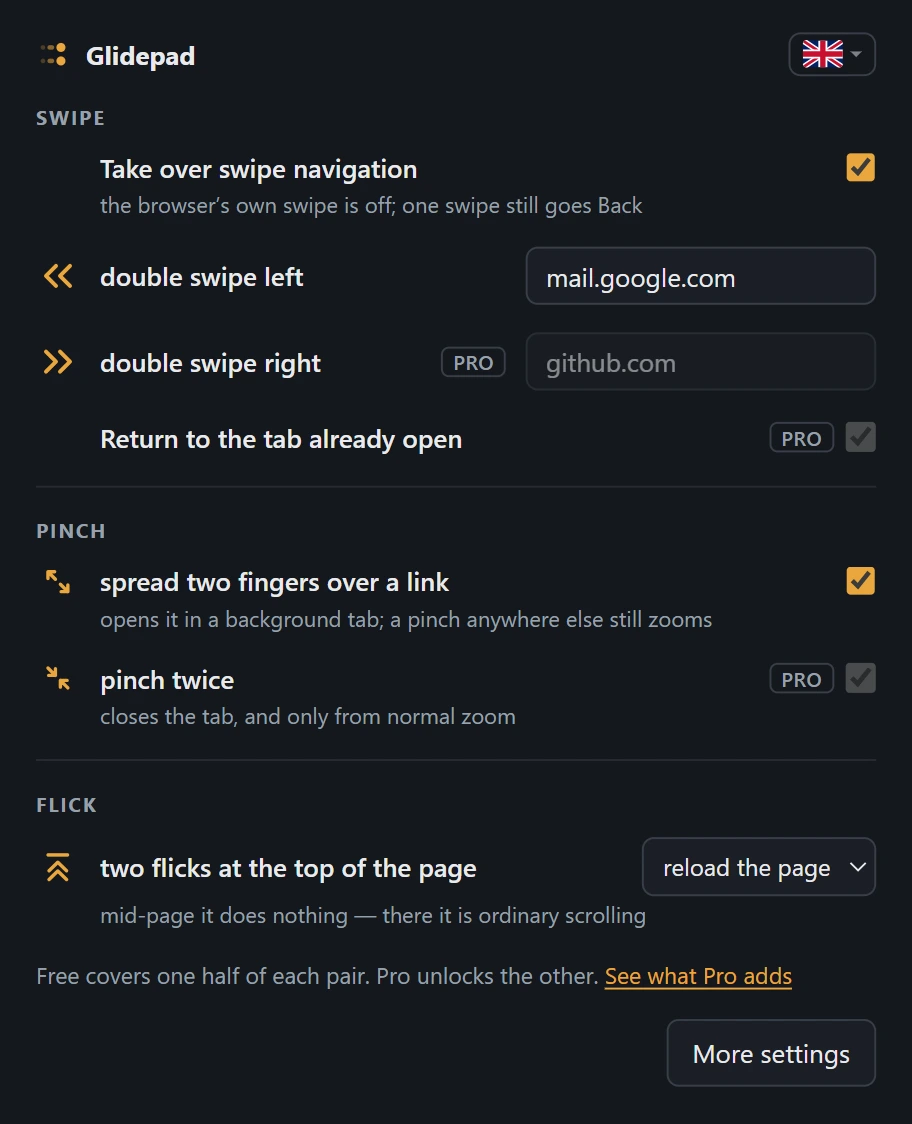
The popup
Click the icon and there is nothing else to find. One row per gesture, named by the movement your fingers make, with the address behind each direction right there in the row. The half of each pair that Pro unlocks is marked, not hidden — you can see what you would be buying before you buy it.
The numbers are one click deeper, behind More settings: how long to wait for a second flick, how far it has to travel, how sharp it has to be. The flag in the corner switches the interface between sixteen languages.
Swipe takeover
Browser swipe navigation fires on the slightest movement, and some pages start it from their own inner scroller. While Glidepad is on it is off across the whole page, both directions, and Glidepad walks history itself. One checkbox in the popup hands it all back.
Tab reuse
A double swipe can open a fresh tab every time, or jump back to the tab it opened last time. Close that tab and the next swipe opens it again.
Tuning
How sharp a flick has to be in px/ms, how long to wait for a second one, how far a movement has to travel, and how far the velocity must jump to count as a new flick rather than a ripple in the tail.
Stays out of the way
While there is still room to scroll sideways under the pointer, the swipe belongs to the page — wide tables and image strips behave exactly as they did. Pinch-zoom is never touched.
Privacy
Glidepad has no backend. There is no account to create, no telemetry to opt out of, and no request leaving your machine — because there is nowhere for one to go.
It does run on every site, and Chrome will tell you so when you install it. That permission exists because gestures happen everywhere, not because anything is being read. The full text is in the privacy policy.
Pricing
Every threshold in the recognizer, and the swipe takeover that keeps the browser out of the gesture, are free and stay free. Pro is the second half of each pair.
Free always
$0
Pro yearly
$19/ year
$1.58 a month, billed once a year
Pro monthly
$2.99/ month
the same Pro, cancel whenever
Prices in USD. Whether tax is added on top or already included depends on where you are; the total is shown before you pay. Pricing in full.
The extension is being finished and the store listing prepared. Leave an address and you get exactly one email when it goes live — no drip sequence, no newsletter.
Questions
Chrome and Edge, built and tested on Windows with a precision touchpad. A Firefox build exists and ships once it has had the same testing.
macOS is not verified yet. Chrome runs there and the same events arrive, but macOS also does its own two-finger navigation, and until that combination has been tested properly it is not a supported platform.
No. On the vertical axis Glidepad never calls preventDefault — it
watches and nothing more, so the page scrolls exactly as it did. Horizontally it
steps in only when there is nothing left to scroll sideways under the pointer,
which is precisely when the browser would have navigated anyway.
Because the second one might still be coming, and there is no way to know before the window closes. The wait is the default 450 ms, it is yours to change, and a direction with no site assigned has no wait at all.
No — the opposite. Glidepad is for the machine you already have open on your knees. A mouse wheel sends the same event type but in large, identical steps; the live check at the top of this page will tell you which one it is looking at.
The software is made and supported by Ivan Korost, working alone. Nothing is on sale yet. When Pro opens, the payment itself will run through a third-party merchant of record — an authorised reseller that becomes the seller on your invoice and handles VAT and sales tax for your country. Its name will be on the checkout, on the receipt and on your card statement, and it will be named here before the first sale.
Then you get your money back — 14 days, no argument, see the refund policy. Try the live check above first: it runs the same recognizer the extension ships with, so if it counts your swipes, so will Glidepad.